

The South Florida Railroad
The South Florida Railroad was incorporated on October 16, 1878, by E. W. Henck, E.F. Crafts, H. Mercer, and Dr. C.C. Haskell, all friends who lived in Orange County, Florida. These men hired F. C. Tucker to be chief engineer, and F.C. Tucker located a line running from Lake Monroe at Sanford to Orlando. The road was projected to run down the state to Charlotte Harbor on the Gulf of Mexico. The South Florida RR was having trouble raising money, but the project really progressed when Edward W. Henck obtained the defunct LM&O charter.
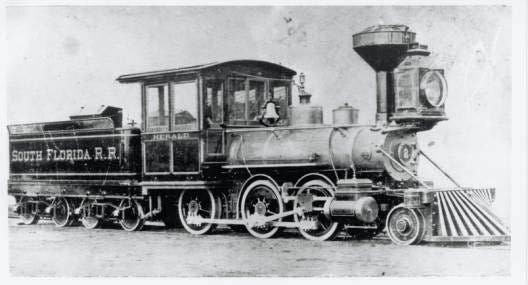
E.W. Henck had a particular reason for wanting to build this railroad. Coming to the area in 1873 from Boston, Henck homesteaded to a site near Myrtle Lake, which he planned out as a small village. He named the town Longwood after a suburb of Boston he had helped to lay out. He knew that if he wanted to sell real estate, Longwood needed to prosper and to do that, reliable rail transportation into the area from Sanford would be essential.
Mr. Henck convinced two prominent investors from Boston that a railroad from Sanford to Orlando and then onward to the Gulf through a new and undeveloped Florida was a solid investment. Henck was made president of the railroad. Traveling back to Florida, he purchased ten straight miles of rail and a little narrow gauge locomotive.
Construction began with former President Ulysses S. Grant putting the first shovel of dirt in 1879. Despite this grand beginning, actual progress was slow as labor was hard to come by in the scarce and undeveloped region. The little locomotive “Seminole,” along with 75 tons of rail, arrived at Sanford by the end of January 1880. By May 20th, seven miles of iron had been laid to Shroder’s Mill. This increased to nineteen miles by the first of July, leaving only three miles to reach Orlando.
Unfortunately, by then, South Florida’s supply of rails had been exhausted, and because of the railroad building boom in the country, there would be a three-month idle of workers in completing the road to Orlando. To make the most of this delay, the entrepreneur Henck began
construction of the Lake Monroe-St. Johns River Wharf at Sanford. It was 800 feet long and could accommodate five steamboats at a time.
Finally, the rails arrived in October, and the last three miles were quickly laid. The first public timetable was issued on November 11, 1880. The Longwood station was on the south side of Church Avenue. There was a passenger entrance as well as a large area for freight shipments.
Want to know what happened to the train tracks today.